Took these photos just before a thunderstorm.
Got some very soggy flowers now.
Abutilon Hardy Red, I had four different colours originally, the other three obviously weren't that hardy.
Lobelia erinus Superstar, still stuck in the greenhouse, really should be outside by now.
Clematis Ice Blue, bought five years ago, putting on its best display yet.
Digitalis purpurea, a self-seeded foxglove. Nature always plants them in the right place.
Corydalis lutea, another self-seeded plant. This one does get a bit giddy though, really have to keep it under control.
Dactylorhiza pupurella, growing in a pot in the greenhouse. Look at those aphids, wildlife at no extra cost.
Hebe, variety unknown, has now outgrown its allotted space. Will be taking cuttings to replace it next year.
Verbena Trailing Red Velvet, another one in the greenhouse awaiting its escape.
Geranium versicolor, just coming into bloom.
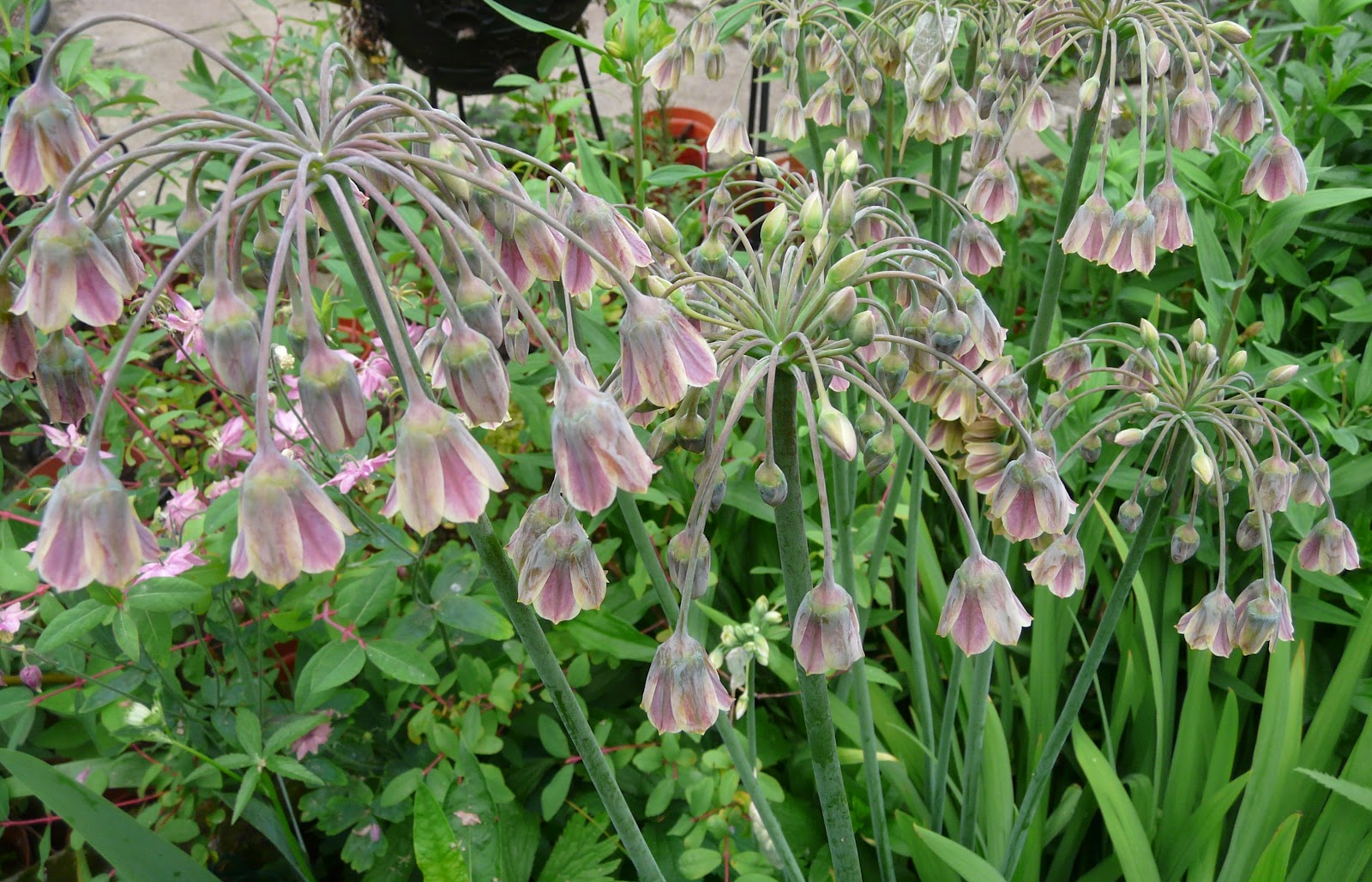
Allium siculum, complete with bee. Don't get me going about the name change, it's an allium, right ?
Osteospermum Voltage Yellow, another one still stuck in the greenhouse.
Thanks to Carol at May Dreams Gardens for hosting. If you want to see what's in bloom around the world today, why not pop over to Carol's blog.
Gardening With Nature in the UK. A blog about allowing Nature to help with the gardening. She's better at it than I am.
Friday, 15 June 2012
Wednesday, 13 June 2012
Fruit For Thought
Or should I say the lack of it.
I'll explain later.
This is Clematis Rebecca, purchased about five years ago, and growing atop an apple tree. It was bred by Raymond Evison, and named after his eldest daughter. This year it has produced its best display ever, and as you can see there are lots of buds to follow.
It was whilst taking this photo that I noticed the apples, or should I say lack of them. The apple tree is Bolero, and it has only a few apples on it this year. Normally it is a prolific cropper. So I decided to check my other apple trees. Three of them have no apples at all, despite producing plenty of blossom earlier. Obviously this is the result of the crazy weather we have had this spring and the lack of pollinators. Ironically, my Polka apple tree is laden with fruit despite not having had much blossom, but it bloomed later than the others, when there must have been more bees around.
I then decided to check my gooseberry bush; two fruits, just two, hardly worth getting the cream out. On a more positive note, the blueberry plants are full of fruit, and the raspberries and strawberries seem to be doing well also. The blackbirds must be licking their beaks in anticipation.
You may recall I mentioned in my last post that I had been nominated for the Sunshine Blog award by Mary at Muse, and that I had to answer some questions. Please feel free to stop reading at this point. Normal service will be resumed next post. Anyway here goes:
Favourite colour: Blue, I'm sure I've answered that one before.
Favourite animal: Dog, Joey would never forgive me if I had chosen anything else.
Favourite number: A winning lottery number. Although I'd need to know it before the lottery was drawn, not much use finding it out afterwards.
Favourite non-alcholic drink; Tea, there's nothing like a nice cuppa tea.
Facebook or Twitter: Twitter, I love the dawn chorus.
My passion: Music, if music be the food of love. Do you know, I'm sure I've heard that before.
Getting or Giving Presents: Tis far better to give than to receive. And I've heard that one before too.
Favourite Pattern: A mackerel sky, one of Nature's magnificent paintings.
Favourite Day of the week: All my working life it was always Saturday, but now I quite like Mondays.
Favourite Flower: Difficult this one, there are so many that I like. Anyway I'll go back to the Fuchsia, see what I did there. It was one of the first flowers that I grew.
And finally I'm supposed to choose five blogs I like. As I explained previously, this I find impossible because there are so many excellent blogs out there, so I'll just direct you to my blog roll for some excellent reading. And thanks again to Mary for nominating me, please check out her blog, it's brill.
I'll explain later.
This is Clematis Rebecca, purchased about five years ago, and growing atop an apple tree. It was bred by Raymond Evison, and named after his eldest daughter. This year it has produced its best display ever, and as you can see there are lots of buds to follow.
It was whilst taking this photo that I noticed the apples, or should I say lack of them. The apple tree is Bolero, and it has only a few apples on it this year. Normally it is a prolific cropper. So I decided to check my other apple trees. Three of them have no apples at all, despite producing plenty of blossom earlier. Obviously this is the result of the crazy weather we have had this spring and the lack of pollinators. Ironically, my Polka apple tree is laden with fruit despite not having had much blossom, but it bloomed later than the others, when there must have been more bees around.
I then decided to check my gooseberry bush; two fruits, just two, hardly worth getting the cream out. On a more positive note, the blueberry plants are full of fruit, and the raspberries and strawberries seem to be doing well also. The blackbirds must be licking their beaks in anticipation.
You may recall I mentioned in my last post that I had been nominated for the Sunshine Blog award by Mary at Muse, and that I had to answer some questions. Please feel free to stop reading at this point. Normal service will be resumed next post. Anyway here goes:
Favourite colour: Blue, I'm sure I've answered that one before.
Favourite animal: Dog, Joey would never forgive me if I had chosen anything else.
Favourite number: A winning lottery number. Although I'd need to know it before the lottery was drawn, not much use finding it out afterwards.
Favourite non-alcholic drink; Tea, there's nothing like a nice cuppa tea.
Facebook or Twitter: Twitter, I love the dawn chorus.
My passion: Music, if music be the food of love. Do you know, I'm sure I've heard that before.
Getting or Giving Presents: Tis far better to give than to receive. And I've heard that one before too.
Favourite Pattern: A mackerel sky, one of Nature's magnificent paintings.
Favourite Day of the week: All my working life it was always Saturday, but now I quite like Mondays.
Favourite Flower: Difficult this one, there are so many that I like. Anyway I'll go back to the Fuchsia, see what I did there. It was one of the first flowers that I grew.
And finally I'm supposed to choose five blogs I like. As I explained previously, this I find impossible because there are so many excellent blogs out there, so I'll just direct you to my blog roll for some excellent reading. And thanks again to Mary for nominating me, please check out her blog, it's brill.
Saturday, 9 June 2012
In The Summertime
When the weather is ........
Mm, that wasn't a very good choice of song, was it ?
This is the first of my David Austin Roses to bloom this year. I bought it over fifteen years ago, along with Graham Thomas and William Shakespeare. Unfortunately, I can't remember the name of this particular variety. It's really had a bit of a rough time. Shortly after it was planted, the nearby Ceanothus grew above it, and it has spent most of its life in the shade. The Ceanothus was removed last year, and the rose started to thrive. Strange that. So this year it has been treated to food for the first time ever, and a mulch. Seems to like it.
The photo was taken a few days ago before the wind and rain, or should I say gales and deluge. This particular bloom is now spread around the lawn, but there are plenty of buds to follow. Weather permitting, of course.
Thought you might like to see this. In the centre of the photo is a young blue tit. Now I'm not saying it's Orville. In fact, after watching Springwatch on TV, I realise that it's highly unlikely that he survived. But I do know that it is one of his siblings. And how do I know that, you may ask. Well, one of Orville's parents had very distinct markings, and today I saw it feeding this little one. And there were a few others twittering in the tree. Yes, they are already on Twitter. They'll have their own Facebook page soon, no doubt.
I also had a visit from a squirrel today. I'm thinking of calling him Harry, as in Houdini. He managed to open not one, but two squirrel-proof feeders twice today. Mind you, the blue tits didn't complain. When he'd gone, they sat on top of the seed, and had a banquet. No wonder the youngsters now look bigger than their parents.
And finally, a big thank you to Mary at Muse, who has nominated me for The Sunshine Blog Award. I am truly honoured. Apparently, I have to answer some questions, so thinking cap on, and I'll answer them in my next post.
Mm, that wasn't a very good choice of song, was it ?
This is the first of my David Austin Roses to bloom this year. I bought it over fifteen years ago, along with Graham Thomas and William Shakespeare. Unfortunately, I can't remember the name of this particular variety. It's really had a bit of a rough time. Shortly after it was planted, the nearby Ceanothus grew above it, and it has spent most of its life in the shade. The Ceanothus was removed last year, and the rose started to thrive. Strange that. So this year it has been treated to food for the first time ever, and a mulch. Seems to like it.
The photo was taken a few days ago before the wind and rain, or should I say gales and deluge. This particular bloom is now spread around the lawn, but there are plenty of buds to follow. Weather permitting, of course.
Thought you might like to see this. In the centre of the photo is a young blue tit. Now I'm not saying it's Orville. In fact, after watching Springwatch on TV, I realise that it's highly unlikely that he survived. But I do know that it is one of his siblings. And how do I know that, you may ask. Well, one of Orville's parents had very distinct markings, and today I saw it feeding this little one. And there were a few others twittering in the tree. Yes, they are already on Twitter. They'll have their own Facebook page soon, no doubt.
I also had a visit from a squirrel today. I'm thinking of calling him Harry, as in Houdini. He managed to open not one, but two squirrel-proof feeders twice today. Mind you, the blue tits didn't complain. When he'd gone, they sat on top of the seed, and had a banquet. No wonder the youngsters now look bigger than their parents.
And finally, a big thank you to Mary at Muse, who has nominated me for The Sunshine Blog Award. I am truly honoured. Apparently, I have to answer some questions, so thinking cap on, and I'll answer them in my next post.
Wednesday, 6 June 2012
A Peony For Your Thoughts
And it's a tree peony too.
This is a Japanese Tree Peony, sorry I don't know which variety it is. I bought it a long time ago, I mean a very long time ago. I purchased two of them and planted them in the front garden. One of them, a lovely yellow double, was planted under the front window, where it just grew and grew. As it was obviously in the wrong place, I decided to move it. Big mistake. Tree peonies don't like moving. It died.
So this one I left alone. It only grows to about four or five feet, dependent on the severity of the winter. It was quite happy until the gas men came and dug up the pavement near the front garden. The gas pipe they were replacing was quite close to the peony's roots. Tree peonies don't like root disturbance. Don't worry , it didn't die, but it did sulk quite a bit. It seems a lot better now than it was last year, so hopefully it is now recovering from the experience.
The flowers are dinner plate size, huge things, but very heavy, and they bow their heads to the ground. So despite having about a dozen blooms at the moment, after the recent rain, the flowers are all facing downwards, and the display is hidden. No point in trying to lift them up; heavy rain forecast for tomorrow. Oh well.
You may have seen in previous posts, the bird feeder I use, which is covered in a squirrel guard. The guard keeps out the squirrels and the large birds, but I wasn't expecting this:
Didn't know snails liked bird seed. On the subject of bird seed, I read a letter recently where someone was asking if birds are particular about the bird food they are given. The letter writer said that if he changed the make of bird food, the birds weren't happy and would ignore the food until their regular make was offered. I too have experienced this. I usually get my bird food from CJ Wildbird Foods, but if on occasion I buy from another supplier, you know special offers and the like, the birds won't eat it. Even food from other very reputable suppliers is ignored. It's as if the birds just don't like change. The BTO say birds can tell which food is best, and they will eat the best food and ignore poorer quality food. I suppose it's a bit like, once you've sampled M&S food, do you really want to go back to Tesco?
This is a Japanese Tree Peony, sorry I don't know which variety it is. I bought it a long time ago, I mean a very long time ago. I purchased two of them and planted them in the front garden. One of them, a lovely yellow double, was planted under the front window, where it just grew and grew. As it was obviously in the wrong place, I decided to move it. Big mistake. Tree peonies don't like moving. It died.
So this one I left alone. It only grows to about four or five feet, dependent on the severity of the winter. It was quite happy until the gas men came and dug up the pavement near the front garden. The gas pipe they were replacing was quite close to the peony's roots. Tree peonies don't like root disturbance. Don't worry , it didn't die, but it did sulk quite a bit. It seems a lot better now than it was last year, so hopefully it is now recovering from the experience.
The flowers are dinner plate size, huge things, but very heavy, and they bow their heads to the ground. So despite having about a dozen blooms at the moment, after the recent rain, the flowers are all facing downwards, and the display is hidden. No point in trying to lift them up; heavy rain forecast for tomorrow. Oh well.
You may have seen in previous posts, the bird feeder I use, which is covered in a squirrel guard. The guard keeps out the squirrels and the large birds, but I wasn't expecting this:
Didn't know snails liked bird seed. On the subject of bird seed, I read a letter recently where someone was asking if birds are particular about the bird food they are given. The letter writer said that if he changed the make of bird food, the birds weren't happy and would ignore the food until their regular make was offered. I too have experienced this. I usually get my bird food from CJ Wildbird Foods, but if on occasion I buy from another supplier, you know special offers and the like, the birds won't eat it. Even food from other very reputable suppliers is ignored. It's as if the birds just don't like change. The BTO say birds can tell which food is best, and they will eat the best food and ignore poorer quality food. I suppose it's a bit like, once you've sampled M&S food, do you really want to go back to Tesco?
Sunday, 3 June 2012
Know Your Onions
Yes, the ornamental onions are in bloom.
This is Allium siculum, a bulbous perennial that seems to thrive in my garden. What's that ? What, it's not an Allium ? Ah well, you see when I bought it, it was in the genus Allium, and that is where it remains for me. If the botanists want to change its name, so be it, but they are not changing my plant label. Oh and if you want to know what it's called now, well it's simply Nectaroscordum siculum. Now that's a memorable name, isn't it ? And you wonder why I'm sticking with the old name. I haven't got a plant label big enough, for a start.
Anyway, the plant itself is a real bee magnet, although there were no bees out today in the rain. Yes, it's June, it's a Bank Holiday weekend in the UK, so it's got to be raining. When the flowers have been pollinated, they fold up and lift upwards, forming a sort of conical shape. The plant is also very good at self seeding, and grows wherever it feels happy. I've had plants coming up quite a distance from the main planting. If you come across it in the bulb catalogues, I highly recommend it.
A few days ago, whilst sat out in the garden, no it doesn't rain every day, I was reminded about why I like to garden for wildlife:
This wood pigeon came to the bird bath just a few feet from where I was sitting, no zoom was used on this photo. The birds and animals have become quite tame over the years. As long as I move slowly and quietly, they just get on with their business as if I wasn't there.
And finally, on a completely different subject, you know how folk are always going on about eating your 'five a day' fruit and veg. I was reading an article in a newspaper the other day, about 10 superfoods that you should eat every day to keep you healthy. All the usual suspects were there, but in at number ten was, wait for it, four, yes four pieces of dark chocolate. That's every day, folks. Must go now, I'm off to eat my 'four a day.'
This is Allium siculum, a bulbous perennial that seems to thrive in my garden. What's that ? What, it's not an Allium ? Ah well, you see when I bought it, it was in the genus Allium, and that is where it remains for me. If the botanists want to change its name, so be it, but they are not changing my plant label. Oh and if you want to know what it's called now, well it's simply Nectaroscordum siculum. Now that's a memorable name, isn't it ? And you wonder why I'm sticking with the old name. I haven't got a plant label big enough, for a start.
Anyway, the plant itself is a real bee magnet, although there were no bees out today in the rain. Yes, it's June, it's a Bank Holiday weekend in the UK, so it's got to be raining. When the flowers have been pollinated, they fold up and lift upwards, forming a sort of conical shape. The plant is also very good at self seeding, and grows wherever it feels happy. I've had plants coming up quite a distance from the main planting. If you come across it in the bulb catalogues, I highly recommend it.
A few days ago, whilst sat out in the garden, no it doesn't rain every day, I was reminded about why I like to garden for wildlife:
This wood pigeon came to the bird bath just a few feet from where I was sitting, no zoom was used on this photo. The birds and animals have become quite tame over the years. As long as I move slowly and quietly, they just get on with their business as if I wasn't there.
And finally, on a completely different subject, you know how folk are always going on about eating your 'five a day' fruit and veg. I was reading an article in a newspaper the other day, about 10 superfoods that you should eat every day to keep you healthy. All the usual suspects were there, but in at number ten was, wait for it, four, yes four pieces of dark chocolate. That's every day, folks. Must go now, I'm off to eat my 'four a day.'
Thursday, 31 May 2012
Horizontal Hold
Except I'm growing it vertically.
This is Cotoneaster horizontalis, planted by nature, not by me. She planted this one at the bottom of a rose arch, shortly after I had removed the old rose. These plants normally grow horizontally, hence the name, but if planted against a wall or arch, they will grow upwards. I first became aware of this plant's versatility several years ago, when I discovered it planted in the car park of a shopping centre. It was planted between the car parking bays, and was regularly clipped. This made the shrubs quite dense, much to the delight of several dunnocks who had made their home there.
My plant isn't dense enough for any nests yet, but in the autumn it is regularly visited by blackbirds who adore the berries. And at this time of year, it really is a bee magnet. Oh, and it attracts other pollinators too like this one:
Are you impressed ? This is the first time I've ever had a holly blue stay still long enough to have its photo taken. Actually, I think it was drunk, it stayed there quite a while before it flew off. And others have been feeding in the garden too:
Look at the expression on the young blackbird's face. It's as if he's saying to his dad, 'what sort of food do you call this ?' Never satisfied, these young uns.
By the way, it's recently been announced that putting up bird feeders acts as good pest control. Scientists have carried out experiments that show that gardens with bird feeders have better pest control than those without. Apparently, whilst the birds are waiting to use the feeders, they will eat the pests on your plants. It's a bit like putting sweets near the checkouts at the supermarkets. Except these 'sweets' are good for the birds. Mind you, I don't think putting broccoli spears near the supermarket checkout would have the same effect as sweets, do you ?
This is Cotoneaster horizontalis, planted by nature, not by me. She planted this one at the bottom of a rose arch, shortly after I had removed the old rose. These plants normally grow horizontally, hence the name, but if planted against a wall or arch, they will grow upwards. I first became aware of this plant's versatility several years ago, when I discovered it planted in the car park of a shopping centre. It was planted between the car parking bays, and was regularly clipped. This made the shrubs quite dense, much to the delight of several dunnocks who had made their home there.
My plant isn't dense enough for any nests yet, but in the autumn it is regularly visited by blackbirds who adore the berries. And at this time of year, it really is a bee magnet. Oh, and it attracts other pollinators too like this one:
Are you impressed ? This is the first time I've ever had a holly blue stay still long enough to have its photo taken. Actually, I think it was drunk, it stayed there quite a while before it flew off. And others have been feeding in the garden too:
Look at the expression on the young blackbird's face. It's as if he's saying to his dad, 'what sort of food do you call this ?' Never satisfied, these young uns.
By the way, it's recently been announced that putting up bird feeders acts as good pest control. Scientists have carried out experiments that show that gardens with bird feeders have better pest control than those without. Apparently, whilst the birds are waiting to use the feeders, they will eat the pests on your plants. It's a bit like putting sweets near the checkouts at the supermarkets. Except these 'sweets' are good for the birds. Mind you, I don't think putting broccoli spears near the supermarket checkout would have the same effect as sweets, do you ?
Sunday, 27 May 2012
A Little Bit Corny
No it's not a corny joke.
As if.
This is Centaurea montana, a perennial cornflower. We used to have these growing under the front window when I was a child. I used to think it was a weed. It never needed any watering, you see, so that's why I presumed it was a weed. This particular plant was purchased earlier this year from Claire Austin Hardy Plants. Apparently, the cornflower regularly escapes from gardens. Now doesn't that make it a weed ? I've planted it near the front of a sunny border, so we'll see how it behaves.
Yet another hot, sunny day today. And whilst I sat in the shade, others did a bit of sunbathing:
This is his favourite spot, on top of the greenhouse. He sits here regularly in the afternoon, and then goes for a drink:
And what about the blue tits ? Well, I last saw Orville on Thursday night. He was still under the apple tree, but he was looking stronger and healthier. The following day, he was gone. There were no tell-tale signs of any struggle, you know, feathers. So, hopefully, he managed to fly. The parents are still feeding their young in neighbouring gardens, and I really hope that Orville is amongst them.
The weathermen are predicting one more fine day before the storms arrive. That'll be fun.
As if.
This is Centaurea montana, a perennial cornflower. We used to have these growing under the front window when I was a child. I used to think it was a weed. It never needed any watering, you see, so that's why I presumed it was a weed. This particular plant was purchased earlier this year from Claire Austin Hardy Plants. Apparently, the cornflower regularly escapes from gardens. Now doesn't that make it a weed ? I've planted it near the front of a sunny border, so we'll see how it behaves.
Yet another hot, sunny day today. And whilst I sat in the shade, others did a bit of sunbathing:
This is his favourite spot, on top of the greenhouse. He sits here regularly in the afternoon, and then goes for a drink:
And what about the blue tits ? Well, I last saw Orville on Thursday night. He was still under the apple tree, but he was looking stronger and healthier. The following day, he was gone. There were no tell-tale signs of any struggle, you know, feathers. So, hopefully, he managed to fly. The parents are still feeding their young in neighbouring gardens, and I really hope that Orville is amongst them.
The weathermen are predicting one more fine day before the storms arrive. That'll be fun.
Thursday, 24 May 2012
Lunch At The Ritz
Who says there is no such thing as a free meal.
I noticed a blue tit sat atop the fat balls in this feeder. It just sat there, and occasionally had a little nibble and then had a rest. They say that if a bird is very lethargic around a bird feeder, it is probably ill. So I decided to investigate and guess what I found. It was a young blue tit. Don't think if it was one of Orville's siblings, because this one could fly quite well. Later in the day it came back and did the same again, until the sun shone directly on the feeder, which must have made it uncomfortable.
You can't blame the young blue tit though; a seat at a table, no-one to disturb you, and plenty of food. What more could you ask for ?
And Orville ? Well he's made his way to the secluded area under the apple tree, and his parents are still feeding him. He's getting louder, so he must be growing, and his siblings are still in the hedges and shrubs around the garden.
I noticed a blue tit sat atop the fat balls in this feeder. It just sat there, and occasionally had a little nibble and then had a rest. They say that if a bird is very lethargic around a bird feeder, it is probably ill. So I decided to investigate and guess what I found. It was a young blue tit. Don't think if it was one of Orville's siblings, because this one could fly quite well. Later in the day it came back and did the same again, until the sun shone directly on the feeder, which must have made it uncomfortable.
You can't blame the young blue tit though; a seat at a table, no-one to disturb you, and plenty of food. What more could you ask for ?
And Orville ? Well he's made his way to the secluded area under the apple tree, and his parents are still feeding him. He's getting louder, so he must be growing, and his siblings are still in the hedges and shrubs around the garden.
Wednesday, 23 May 2012
Wish I Could Fly
Way up to the sky, but I can't.
I'm thinking of calling him Orville. Do you remember that duck, and that song ? Yes, it's been another traumatic day with the blue tit chicks today.
I went out into the garden this morning, hoping that the youngsters had moved to safety, when one of them tumbled onto the lawn. I found another one in the apple tree, and Orville was still on the ground. At least he'd managed to travel the full length of the patio. The other siblings had made it to relative safety, they were tweeting in the shrubs. Not on their mobile phones, come on, they're not old enough for that just yet.
Full credit to the parents, who continued to feed Orville throughout the day, and he was getting quite vocal too. They could easily have abandoned him, but they didn't.
In previous years, when the blue tits left the nestbox, they flew into the hawthorns at the bottom of the garden, and went into hiding for a couple of weeks. Re-emerging as 'teenagers' demonstrating their acrobatic skills. But not this year, oh no, the entire family are still very close to the house.
As a result I couldn't sit out in the garden or do any gardening, apart from watering the plants in the greenhouse; they were very thirsty. Oh well, there's always tomorrow.
I'm thinking of calling him Orville. Do you remember that duck, and that song ? Yes, it's been another traumatic day with the blue tit chicks today.
I went out into the garden this morning, hoping that the youngsters had moved to safety, when one of them tumbled onto the lawn. I found another one in the apple tree, and Orville was still on the ground. At least he'd managed to travel the full length of the patio. The other siblings had made it to relative safety, they were tweeting in the shrubs. Not on their mobile phones, come on, they're not old enough for that just yet.
Full credit to the parents, who continued to feed Orville throughout the day, and he was getting quite vocal too. They could easily have abandoned him, but they didn't.
In previous years, when the blue tits left the nestbox, they flew into the hawthorns at the bottom of the garden, and went into hiding for a couple of weeks. Re-emerging as 'teenagers' demonstrating their acrobatic skills. But not this year, oh no, the entire family are still very close to the house.
As a result I couldn't sit out in the garden or do any gardening, apart from watering the plants in the greenhouse; they were very thirsty. Oh well, there's always tomorrow.
Tuesday, 22 May 2012
The Great Escape
Or how the best laid plans don't always work.
With the gorgeous weather we've had today, I decided to sit out on the lawn with my dog, Joey. I positioned my chair so that I could watch the blue tits, but was far enough away from the nestbox so as not to disturb them. I soon noticed that something wasn't right again. They were going to the box but not feeding anything, just like last Sunday. On that occasion, I found a small dead baby blue tit under the nestbox that night.
I presumed that all the chicks would be of the same size, and not ready to leave the nest yet. Wrong. As we were sat there on the lawn, a fully fledged young blue tit tumbled out of the flower border and landed on the lawn. I grabbed hold of Joey and took him indoors. Then I decided to observe a while from the kitchen window. It soon became clear that the youngsters were all over the place at ground level. Think they had left the nest a little bit too soon, probably because of the warm sunshine blazing onto the nestbox.
And when I did venture outside again, I found the little chap above, had fallen into a large trug. He was much smaller than his siblings, and unable to get out of the trug. So I laid the trug on its side, and he scrambled out into the undergrowth. Unfortunately, his parents couldn't find him. They kept flying to the trug and then to the nestbox.
So I went back outside, and found him huddled in the plants where I'd left him. As his parents had been looking for him in the nestbox, I reluctantly decided to return him there. Normally young birds are best left for the parents to find them, but this one wasn't safe where he was. His parents found him in the box, but he came out again later, and I decided to leave him this time.
I'm now unable to water my greenhouse plants or mow the lawn, as the blue tits are still feeding their young on the ground. Hopefully, by tomorrow, the youngsters will have scrambled up into the shrubs, and relative safety.
With the gorgeous weather we've had today, I decided to sit out on the lawn with my dog, Joey. I positioned my chair so that I could watch the blue tits, but was far enough away from the nestbox so as not to disturb them. I soon noticed that something wasn't right again. They were going to the box but not feeding anything, just like last Sunday. On that occasion, I found a small dead baby blue tit under the nestbox that night.
I presumed that all the chicks would be of the same size, and not ready to leave the nest yet. Wrong. As we were sat there on the lawn, a fully fledged young blue tit tumbled out of the flower border and landed on the lawn. I grabbed hold of Joey and took him indoors. Then I decided to observe a while from the kitchen window. It soon became clear that the youngsters were all over the place at ground level. Think they had left the nest a little bit too soon, probably because of the warm sunshine blazing onto the nestbox.
And when I did venture outside again, I found the little chap above, had fallen into a large trug. He was much smaller than his siblings, and unable to get out of the trug. So I laid the trug on its side, and he scrambled out into the undergrowth. Unfortunately, his parents couldn't find him. They kept flying to the trug and then to the nestbox.
So I went back outside, and found him huddled in the plants where I'd left him. As his parents had been looking for him in the nestbox, I reluctantly decided to return him there. Normally young birds are best left for the parents to find them, but this one wasn't safe where he was. His parents found him in the box, but he came out again later, and I decided to leave him this time.
I'm now unable to water my greenhouse plants or mow the lawn, as the blue tits are still feeding their young on the ground. Hopefully, by tomorrow, the youngsters will have scrambled up into the shrubs, and relative safety.
Sunday, 20 May 2012
Come What May
Yes, the May tree is now in full bloom.
This is Crataegus monogyna, my that rolls off the tongue doesn't it ? Fortunately, it is more commonly known as Hawthorn. It is a native plant which usually grows as a shrub. I have a hawthorn hedge at the bottom of the garden. It was planted, probably by a farmer, to separate gardens from his field. It was a substantial hedge, having been double planted, in two rows. Unfortunately, when the bulldozers moved in, prior to houses being built on the field, they removed one row of the hedging. Sad to say, the remaining hedge is really struggling; now competing with a leylandii hedge that the new house owners have planted on their side of the boundary.
This photo though, is of the hawthorn tree that also grows at the bottom of the garden. Hawthorn is an excellent plant for wildlife. It attracts a large number of insects, over 150 different species, who in turn attract many birds. I have a wren currently nesting in a hole in the tree. In late summer, blackbirds and fieldfares eat the berries. It is said that waxwings are also partial to the haws, but I have not had any waxwings in the garden, at least not yet anyway. But I have had a visit from a very noisy family:
Yes, a family of starlings have discovered the garden. The youngsters, and there are lots of them, are very greedy. But they do look cute too. And the blue tits ?
Strange goings on today. This morning, one of the parents was flying back and forth from the box with food in its beak, but not appearing to feed anyone in the box. I've seen this behaviour before, when the parents are trying to entice the young out of the box, but I don't think these youngsters are anywhere near ready yet. Glad to report that normal service resumed later in the morning, with both parents feeding and removing white sacs too.
This is Crataegus monogyna, my that rolls off the tongue doesn't it ? Fortunately, it is more commonly known as Hawthorn. It is a native plant which usually grows as a shrub. I have a hawthorn hedge at the bottom of the garden. It was planted, probably by a farmer, to separate gardens from his field. It was a substantial hedge, having been double planted, in two rows. Unfortunately, when the bulldozers moved in, prior to houses being built on the field, they removed one row of the hedging. Sad to say, the remaining hedge is really struggling; now competing with a leylandii hedge that the new house owners have planted on their side of the boundary.
This photo though, is of the hawthorn tree that also grows at the bottom of the garden. Hawthorn is an excellent plant for wildlife. It attracts a large number of insects, over 150 different species, who in turn attract many birds. I have a wren currently nesting in a hole in the tree. In late summer, blackbirds and fieldfares eat the berries. It is said that waxwings are also partial to the haws, but I have not had any waxwings in the garden, at least not yet anyway. But I have had a visit from a very noisy family:
Yes, a family of starlings have discovered the garden. The youngsters, and there are lots of them, are very greedy. But they do look cute too. And the blue tits ?
Strange goings on today. This morning, one of the parents was flying back and forth from the box with food in its beak, but not appearing to feed anyone in the box. I've seen this behaviour before, when the parents are trying to entice the young out of the box, but I don't think these youngsters are anywhere near ready yet. Glad to report that normal service resumed later in the morning, with both parents feeding and removing white sacs too.
Tuesday, 15 May 2012
Garden Bloggers' Bloom Day - May 2012
It's that time of the month again.
You know, when the flowers become quite shy.
Self-sown Forget-Me-Nots, in various shades of blue and pink.
Solomon's Seal, a gift from a friend of mine many years ago, thriving in dry shade under a tree. The plant that is, not my friend.
Paeony-flowered Tulips, the yellow and red ones have gone over now, but these are continuing the display.
Iris Eramosa Skies, a dwarf bearded iris, purchased last year from Claire Austin Hardy Plants.
Cymbalaria muralis, commonly known as the Kenilworth Ivy. It can become a bit of a weed if left to its own devices, but it is easily kept under control.
Strawberry Buddy, bought this year from Thompson & Morgan, and the first of my strawberries to flower this year.
Iris Eyebright, another dwarf bearded iris from Claire Austin. Lovely flower.
Bluebells, Spanish ones though, wish I had known that they were so invasive before I bought them. Too late now, my English Bluebells have disappeared.
Clematis, variety unknown, flowering at the top of an apple tree.
Lobelia erinus Superstar, stuck in the greenhouse, eagerly awaiting their escape into hanging baskets. I grew this last year as well, and highly recommend it, blooms all summer.
Lewisia hybrid, also in the greenhouse, but quite happy in there.
Lilac, flowering in my neighbour's garden. What do you mean that's cheating ? No it's not. You see, it may be flowering over the hedge, but it is actually growing in my garden. I had the shrub pruned last year because it had grown too large, but as you can see, one branch escaped.
Thanks to Carol at May Dreams Gardens for hosting the Garden Bloggers' Bloom Day. Why not pop over and see what is blooming in gardens all over the world in this month.
You know, when the flowers become quite shy.
Self-sown Forget-Me-Nots, in various shades of blue and pink.
Solomon's Seal, a gift from a friend of mine many years ago, thriving in dry shade under a tree. The plant that is, not my friend.
Paeony-flowered Tulips, the yellow and red ones have gone over now, but these are continuing the display.
Iris Eramosa Skies, a dwarf bearded iris, purchased last year from Claire Austin Hardy Plants.
Cymbalaria muralis, commonly known as the Kenilworth Ivy. It can become a bit of a weed if left to its own devices, but it is easily kept under control.
Strawberry Buddy, bought this year from Thompson & Morgan, and the first of my strawberries to flower this year.
Iris Eyebright, another dwarf bearded iris from Claire Austin. Lovely flower.
Bluebells, Spanish ones though, wish I had known that they were so invasive before I bought them. Too late now, my English Bluebells have disappeared.
Clematis, variety unknown, flowering at the top of an apple tree.
Lobelia erinus Superstar, stuck in the greenhouse, eagerly awaiting their escape into hanging baskets. I grew this last year as well, and highly recommend it, blooms all summer.
Lewisia hybrid, also in the greenhouse, but quite happy in there.
Lilac, flowering in my neighbour's garden. What do you mean that's cheating ? No it's not. You see, it may be flowering over the hedge, but it is actually growing in my garden. I had the shrub pruned last year because it had grown too large, but as you can see, one branch escaped.
Thanks to Carol at May Dreams Gardens for hosting the Garden Bloggers' Bloom Day. Why not pop over and see what is blooming in gardens all over the world in this month.
Sunday, 13 May 2012
Take A Giant Step
Literally.
This is my step-over apple tree, although I think you'd need to be a giant to step over it. Perhaps I should explain. Have you ever done something that seemed to be a good idea at the time ? Then circumstances change, and that good idea turns into a disaster. I decided to grow a step-over apple tree after watching a TV programme many years ago. You can buy step-over apple trees, but they are very expensive. It is quite easy to produce your own. It is, really, mine didn't always look like this.
First of all, you need a one year old apple tree with two strong branches low down the stem. Plant the tree, and train the two branches along a horizontal wire. Remove the leader and any other branches. There you are, job done. You should now have a T-shaped apple tree. As the tree grows, you should continue to train the branches along the horizontal wire, and prune as if growing a cordon tree.
So what did I do wrong, you may ask. As I had started with such a young tree, it took a few years to produce its first fruit, but eventually it did. And this coincided with the arrival of our first puppy, a golden retriever named Benji. Although he was quite small, those apples looked just like a ball to him, and one by one he leapt up and pulled them off the tree.
The following year, Benji was older and wiser. No longer did he have to jump to reach the fruit, they were now at eye-level. So from then on, ever year he would watch the apples grow, and pick them when he thought they were ripe enough to eat. And the dogs that followed Benji continued his apple harvesting technique. So that is why I abandoned the step-over bit and allowed the tree to grow upwards. Although, as you can see, there will still be plenty of apples for Joey this year.
And finally, the blue tits are constantly in and out of the nestbox these days, feeding their young, and occasionally departing with little white sacs in their beaks. I won't go into too much detail, but suffice to say, what goes in must come out.
This is my step-over apple tree, although I think you'd need to be a giant to step over it. Perhaps I should explain. Have you ever done something that seemed to be a good idea at the time ? Then circumstances change, and that good idea turns into a disaster. I decided to grow a step-over apple tree after watching a TV programme many years ago. You can buy step-over apple trees, but they are very expensive. It is quite easy to produce your own. It is, really, mine didn't always look like this.
First of all, you need a one year old apple tree with two strong branches low down the stem. Plant the tree, and train the two branches along a horizontal wire. Remove the leader and any other branches. There you are, job done. You should now have a T-shaped apple tree. As the tree grows, you should continue to train the branches along the horizontal wire, and prune as if growing a cordon tree.
So what did I do wrong, you may ask. As I had started with such a young tree, it took a few years to produce its first fruit, but eventually it did. And this coincided with the arrival of our first puppy, a golden retriever named Benji. Although he was quite small, those apples looked just like a ball to him, and one by one he leapt up and pulled them off the tree.
The following year, Benji was older and wiser. No longer did he have to jump to reach the fruit, they were now at eye-level. So from then on, ever year he would watch the apples grow, and pick them when he thought they were ripe enough to eat. And the dogs that followed Benji continued his apple harvesting technique. So that is why I abandoned the step-over bit and allowed the tree to grow upwards. Although, as you can see, there will still be plenty of apples for Joey this year.
And finally, the blue tits are constantly in and out of the nestbox these days, feeding their young, and occasionally departing with little white sacs in their beaks. I won't go into too much detail, but suffice to say, what goes in must come out.
Wednesday, 9 May 2012
A Bunch Of Grapes
In a manner of speaking.
This is Iris Grapelet, a miniature dwarf bearded iris. Bred by J.T.Aitken and introduced in 1989. It normally grows to about 5 inches tall, but with the highest April rainfall for 130 years, I suppose we can forgive it for growing a little higher this year. I grow it in a trough on the patio, where it gets good drainage and sunshine. This year, the leaves have been nibbled by slugs and snails. Normally not a problem in the trough, where it is usually quite dry, but this year isn't normal, is it ?
Those lovely people at Trehane have sent me another e-mail about caring for my blueberries. Apparently, now is the time to feed them. So that's a job for this weekend I think. Trehane really do take customer care to a new level. Maybe other specialist nurseries could take note, and inform their customers when it is time to feed and prune their plants. Just a thought.
I planted a Magnolia stellata this afternoon, a much-appreciated gift from my workmates. I dug the hole, put all the good stuff in, like you do, and planted it. The only job I didn't do, was water it in. As you know, I like to garden with Nature, and as she is about to dump over one inch of rain here tonight, I decided to leave the watering to her. She's better at it than I am.
And finally, a bit of good news; the hawthorn is blooming. Remember the saying:
'Never cast a clout,
Before May is out.'
I have found this to be a very reliable saying, as once the May blossom is out, we shouldn't get any more frosts. But do allow for any frost pockets in your area. The hawthorn hedges, in the fields where I walk the dog, have been in bloom for over a week, but they are at the top of a south-facing hill. The tree in my garden has only just started opening its blooms today.
This is Iris Grapelet, a miniature dwarf bearded iris. Bred by J.T.Aitken and introduced in 1989. It normally grows to about 5 inches tall, but with the highest April rainfall for 130 years, I suppose we can forgive it for growing a little higher this year. I grow it in a trough on the patio, where it gets good drainage and sunshine. This year, the leaves have been nibbled by slugs and snails. Normally not a problem in the trough, where it is usually quite dry, but this year isn't normal, is it ?
Those lovely people at Trehane have sent me another e-mail about caring for my blueberries. Apparently, now is the time to feed them. So that's a job for this weekend I think. Trehane really do take customer care to a new level. Maybe other specialist nurseries could take note, and inform their customers when it is time to feed and prune their plants. Just a thought.
I planted a Magnolia stellata this afternoon, a much-appreciated gift from my workmates. I dug the hole, put all the good stuff in, like you do, and planted it. The only job I didn't do, was water it in. As you know, I like to garden with Nature, and as she is about to dump over one inch of rain here tonight, I decided to leave the watering to her. She's better at it than I am.
And finally, a bit of good news; the hawthorn is blooming. Remember the saying:
'Never cast a clout,
Before May is out.'
I have found this to be a very reliable saying, as once the May blossom is out, we shouldn't get any more frosts. But do allow for any frost pockets in your area. The hawthorn hedges, in the fields where I walk the dog, have been in bloom for over a week, but they are at the top of a south-facing hill. The tree in my garden has only just started opening its blooms today.
Sunday, 6 May 2012
Fine And Dandy
Or the lion's tooth.
This is Taraxacum officinale, a herbaceous perennial, sometimes grown as a medicinal herb. What ? What do you mean, it's a weed ?
And here it is growing with Honesty. Oh alright then, I suppose some people would call it a weed. In fact, everybody calls it a weed. Yes, it's the humble dandelion, named from the French phrase 'dent de lion' meaning lion's tooth, a reference to its jagged leaves. Much has been written about its medicinal and culinary properties, but I intend to concentrate on its advantages to the garden. Yes, there are advantages. Really.
Firstly, one thing to bear in mind if you do decide to allow a few to grow in your garden; one plant can produce 5,000 seeds in one year. So on no account allow it to go to seed. And now for the benefits; it attracts pollinating insects. So do a lot of cultivated flowers, I hear you say. Hang on, I haven't finished yet. It releases ethylene gas that encourages fruit setting and ripening. So does a banana, I know, but there's more; its deep taproot brings nutrients and minerals to the surface, enriching the soil especially for shallow-rooted plants.
So believe it or not, and you probably don't, but I do allow a few dandelions to grow amongst the fruit trees on purpose. I always pull off the spent blooms before they seed, and occasionally I pull off some leaves for the compost bin. I bet you feel better about the dandelions in your lawn now, don't you ?
The full moon this morning has been described as a 'supermoon.' It looked 14% larger and 30% brighter than normal, because it was so close to the earth. Hope you all remembered to plant and sow 48 hours before the full moon. I didn't. Forgot. Whoops.
And finally, the blue tits. Yesterday I saw a delightful and disturbing sight; the male blue tit enticed the female out of the nestbox with a big juicy grub. The disturbing bit ? He got the grub from the tree at the bottom of the garden. I walk under that tree. Today both birds are in and out of the nestbox, looks like the eggs are hatching.
This is Taraxacum officinale, a herbaceous perennial, sometimes grown as a medicinal herb. What ? What do you mean, it's a weed ?
And here it is growing with Honesty. Oh alright then, I suppose some people would call it a weed. In fact, everybody calls it a weed. Yes, it's the humble dandelion, named from the French phrase 'dent de lion' meaning lion's tooth, a reference to its jagged leaves. Much has been written about its medicinal and culinary properties, but I intend to concentrate on its advantages to the garden. Yes, there are advantages. Really.
Firstly, one thing to bear in mind if you do decide to allow a few to grow in your garden; one plant can produce 5,000 seeds in one year. So on no account allow it to go to seed. And now for the benefits; it attracts pollinating insects. So do a lot of cultivated flowers, I hear you say. Hang on, I haven't finished yet. It releases ethylene gas that encourages fruit setting and ripening. So does a banana, I know, but there's more; its deep taproot brings nutrients and minerals to the surface, enriching the soil especially for shallow-rooted plants.
So believe it or not, and you probably don't, but I do allow a few dandelions to grow amongst the fruit trees on purpose. I always pull off the spent blooms before they seed, and occasionally I pull off some leaves for the compost bin. I bet you feel better about the dandelions in your lawn now, don't you ?
The full moon this morning has been described as a 'supermoon.' It looked 14% larger and 30% brighter than normal, because it was so close to the earth. Hope you all remembered to plant and sow 48 hours before the full moon. I didn't. Forgot. Whoops.
And finally, the blue tits. Yesterday I saw a delightful and disturbing sight; the male blue tit enticed the female out of the nestbox with a big juicy grub. The disturbing bit ? He got the grub from the tree at the bottom of the garden. I walk under that tree. Today both birds are in and out of the nestbox, looks like the eggs are hatching.
Wednesday, 2 May 2012
Seeing Red
The lily beetles are here.
If you find one of these in your garden, especially on your lilies, don't panic. Oh go on then, panic. The lily beetle is not native to the UK or the USA, so yes you've guessed it, no natural predators. The birds won't eat them, they squeak when attacked, yes they do. Would you tuck into your dinner if it squeaked as your fork approached the plate ?
I first noticed these beetles earlier this year in the summer, sorry I mean March. The lilies were only just poking through the soil, so the beetles didn't have much to eat. Needless to say, I disposed of them, but now they're back again. And love is in the air:
As you can see, they had been nibbling the lily leaves before they got amorous. If I had left them, the female would have laid her eggs on the underside of the lily leaves. The resultant larvae cover themselves in their own excrement, so that they look like bird droppings. But you don't find bird droppings underneath leaves, unless the birds in your garden think they are Red Arrow pilots and like to do aerobatics. Come to think of it, but that's another story.
So how do you control them? In parts of Europe, the beetle is kept under control by parasitic wasps, but in the UK only two species of these wasps have been discovered, and certainly not in sufficient numbers to have any effect. So at the moment, the solution is to pick them off the plants and destroy them. The adults are easy to see, although a little tough to squash, they have harder shells than vine weevils. Look under the leaves for larvae and eggs, and remove them also. And if all else fails, don't grow lilies or fritillarias.
On a happier note, the blue tits did manage to evict the bee from their nestbox. They are very discreetly coming in and out of the box. Looks like the eggs have been laid, but no activity yet to suggest any have hatched yet.
And the final April rainfall figures for Sheffield have just been announced. We had 177mm, that's just a smidgen under 7 inches in real money. Wonder what May will have in store for us.
If you find one of these in your garden, especially on your lilies, don't panic. Oh go on then, panic. The lily beetle is not native to the UK or the USA, so yes you've guessed it, no natural predators. The birds won't eat them, they squeak when attacked, yes they do. Would you tuck into your dinner if it squeaked as your fork approached the plate ?
I first noticed these beetles earlier this year in the summer, sorry I mean March. The lilies were only just poking through the soil, so the beetles didn't have much to eat. Needless to say, I disposed of them, but now they're back again. And love is in the air:
As you can see, they had been nibbling the lily leaves before they got amorous. If I had left them, the female would have laid her eggs on the underside of the lily leaves. The resultant larvae cover themselves in their own excrement, so that they look like bird droppings. But you don't find bird droppings underneath leaves, unless the birds in your garden think they are Red Arrow pilots and like to do aerobatics. Come to think of it, but that's another story.
So how do you control them? In parts of Europe, the beetle is kept under control by parasitic wasps, but in the UK only two species of these wasps have been discovered, and certainly not in sufficient numbers to have any effect. So at the moment, the solution is to pick them off the plants and destroy them. The adults are easy to see, although a little tough to squash, they have harder shells than vine weevils. Look under the leaves for larvae and eggs, and remove them also. And if all else fails, don't grow lilies or fritillarias.
On a happier note, the blue tits did manage to evict the bee from their nestbox. They are very discreetly coming in and out of the box. Looks like the eggs have been laid, but no activity yet to suggest any have hatched yet.
And the final April rainfall figures for Sheffield have just been announced. We had 177mm, that's just a smidgen under 7 inches in real money. Wonder what May will have in store for us.
Sunday, 29 April 2012
Taking The Lid Off Things
Or how to break-in to a squirrel-proof feeder.
Here's the culprit having a drink from a plant container full of rainwater. Fortunately, the container didn't have a plant in it. Although aquatic plants would be quite happy in there at the moment.
And after having a drink, he decided to check out a large plant pot, looking for food.
But eventually he found the bird feeders. These are all squirrel-proof, supposedly.
And at first, he did struggle a bit. That looks painful.
But then he decided to just remove the lid. Easy peasy.
These photos were taken yesterday, because it's raining again today. My camera's not waterproof, and neither am I for that matter. Now I know that rain is not a 'once in a lifetime' event, even though Sheffield had broken its 130 year old record for April rainfall with 153.4mm (that's 6 inches in real money) by Friday. Hang on a minute, that is a 'once in a lifetime' event isn't it ?
Will be interesting to see what the final April rainfall total for Sheffield will be. And would you believe, they are forecasting a heatwave for tomorrow ? Yes, they are. Really.
Here's the culprit having a drink from a plant container full of rainwater. Fortunately, the container didn't have a plant in it. Although aquatic plants would be quite happy in there at the moment.
And after having a drink, he decided to check out a large plant pot, looking for food.
But eventually he found the bird feeders. These are all squirrel-proof, supposedly.
And at first, he did struggle a bit. That looks painful.
But then he decided to just remove the lid. Easy peasy.
These photos were taken yesterday, because it's raining again today. My camera's not waterproof, and neither am I for that matter. Now I know that rain is not a 'once in a lifetime' event, even though Sheffield had broken its 130 year old record for April rainfall with 153.4mm (that's 6 inches in real money) by Friday. Hang on a minute, that is a 'once in a lifetime' event isn't it ?
Will be interesting to see what the final April rainfall total for Sheffield will be. And would you believe, they are forecasting a heatwave for tomorrow ? Yes, they are. Really.
Wednesday, 25 April 2012
The Good, The Bad And
The not so ugly.
In fact, it's not ugly at all.
This is Berberis darwinii, an evergreen shrub discovered in South America by Charles Darwin in 1835. That is, if you ignore the fact that prehistoric man was eating the berries many years earlier. However, being as prehistoric man wasn't into the naming of plants, probably too busy running away from mammoths, the shrub was named after Darwin.
My plant was grown by Nature, not by me. It really is an excellent wildlife plant. At this time of year, it is in full bloom, a real bee magnet. When the flowers have finished, the birds move in and nest in the prickly branches. The foliage is like small holly leaves. If you're wondering why the birds aren't nesting here now, well would you want to live with the constant hum of bees ? No, thought not. Later in the season, the shrub produces berries that are quickly devoured by the birds.
And the good and the bad bit ? Well, here in the UK, Berberis darwinii has been given the Award Of Garden Merit, a sort of plant Oscar, by the Royal Horticultural Society. But in New Zealand it has escaped into the wild, and is considered to be a plant pest. It's not often that a plant attracts such opposite views, dependent on where you live.
You may recall, in my last post I mentioned that I had been nominated for the Versatile Blogger award by Mary at Going Native, and that I needed to put my thinking cap on before responding to the rules. Well job done, so here goes:
Firstly, I have to list seven things about myself. You have my permission to log off now if you wish.
1. I'm a plantaholic. I have to attend those meetings, now what are they called ? Oh yes, plant fairs.
2. My favourite colour is blue, the colour of the sky and the sea and I could go on. I usually do.
3. My favourite band is The Ukulele Orchestra Of Great Britain. If you've never heard of them, and you probably haven't, check them out on YouTube.
4. I love quirky, unusual gadgets, like the window vac. Yes, I vacuum my greenhouse, doesn't everyone ?
5. My blogger name was inspired by a variety of lettuce; Little Gem. Now I know that a crystal isn't actually a gem, but we can't let facts get in the way of a good story.
6. I'm a musician and a songwriter, and had one of my songs banned by the BBC. It wasn't rude, by the way.
7. I'm not getting any younger, but thanks to the government, I'm not getting any nearer to retirement age either.
As for the bit about nominating 15 blogs, this is where I break the rules. My blog list contains far more than 15 blogs, many of them already have this award, and some are award free blogs. So to solve this predicament, I'll just say if you want to read some really great blogs, check out my blog list for starters.
In fact, it's not ugly at all.
This is Berberis darwinii, an evergreen shrub discovered in South America by Charles Darwin in 1835. That is, if you ignore the fact that prehistoric man was eating the berries many years earlier. However, being as prehistoric man wasn't into the naming of plants, probably too busy running away from mammoths, the shrub was named after Darwin.
My plant was grown by Nature, not by me. It really is an excellent wildlife plant. At this time of year, it is in full bloom, a real bee magnet. When the flowers have finished, the birds move in and nest in the prickly branches. The foliage is like small holly leaves. If you're wondering why the birds aren't nesting here now, well would you want to live with the constant hum of bees ? No, thought not. Later in the season, the shrub produces berries that are quickly devoured by the birds.
And the good and the bad bit ? Well, here in the UK, Berberis darwinii has been given the Award Of Garden Merit, a sort of plant Oscar, by the Royal Horticultural Society. But in New Zealand it has escaped into the wild, and is considered to be a plant pest. It's not often that a plant attracts such opposite views, dependent on where you live.
You may recall, in my last post I mentioned that I had been nominated for the Versatile Blogger award by Mary at Going Native, and that I needed to put my thinking cap on before responding to the rules. Well job done, so here goes:
Firstly, I have to list seven things about myself. You have my permission to log off now if you wish.
1. I'm a plantaholic. I have to attend those meetings, now what are they called ? Oh yes, plant fairs.
2. My favourite colour is blue, the colour of the sky and the sea and I could go on. I usually do.
3. My favourite band is The Ukulele Orchestra Of Great Britain. If you've never heard of them, and you probably haven't, check them out on YouTube.
4. I love quirky, unusual gadgets, like the window vac. Yes, I vacuum my greenhouse, doesn't everyone ?
5. My blogger name was inspired by a variety of lettuce; Little Gem. Now I know that a crystal isn't actually a gem, but we can't let facts get in the way of a good story.
6. I'm a musician and a songwriter, and had one of my songs banned by the BBC. It wasn't rude, by the way.
7. I'm not getting any younger, but thanks to the government, I'm not getting any nearer to retirement age either.
As for the bit about nominating 15 blogs, this is where I break the rules. My blog list contains far more than 15 blogs, many of them already have this award, and some are award free blogs. So to solve this predicament, I'll just say if you want to read some really great blogs, check out my blog list for starters.
Sunday, 22 April 2012
The Story Of Beetlemania
The life story of the fab four in the UK.
No, not John, George, Paul and Ringo. I'll explain later.
This is Apple Red Valentine, another columnar apple tree, but this one is a little different. I purchased it last year. It bloomed but didn't produce any fruit, which was a good thing, because it allowed it to get established. It's growing on one of the new dwarf root stocks and is planted in a large pot on the patio. As you can see the blossom is a lovely pink colour, but would you believe, the fruit will be deep red, and the flesh will be red also. The flavour is supposed to resemble strawberries. Can't wait. I'll let you know if that's true later in the year.
Now then, the beatles, sorry I mean beetles. May I introduce to you; Violet, Black, Rugged and Short-Neck. Yes, the original fab four, known as oil beetles. They are very rare, and the subject of a wildlife survey organised by Buglife. My reason for introducing them to you, is the amazing story of their life cycle that I read about recently. Are you sitting comfortably ?
Female oil beetles are quite large, flightless beetles who tend to live in grassland areas. They only live for a few months, and spend their time eating grasses and searching for a mate. Once they have mated, they grow even larger, and dig a burrow in which to lay their eggs. The eggs hatch, and the resultant larvae clamber up into flowers, awaiting the arrival of a solitary bee. Now I've got two questions here; how do they know which flowers attract bees, and how do they recognise a solitary bee ?
On with the story. When a solitary bee arrives, they jump onto it, Indiana Jones style I would imagine, and hitch a ride to its nest. Here they feed on the collected nectar and pollen and the bee's eggs. Then they pupate and overwinter in the bee's nest, emerging in the spring as fully grown adults. Apparently, oil beetles are in decline, good news for the solitary bees though. Isn't nature amazing ?
And finally a big thank you to Mary at Going Native who has nominated me for The Versatile Blogger award. In accepting the award, I have to tell you 7 things about myself, and nominate 15 other bloggers for the award. So thinking cap on, I'll see what I can come up with in my next post.
No, not John, George, Paul and Ringo. I'll explain later.
This is Apple Red Valentine, another columnar apple tree, but this one is a little different. I purchased it last year. It bloomed but didn't produce any fruit, which was a good thing, because it allowed it to get established. It's growing on one of the new dwarf root stocks and is planted in a large pot on the patio. As you can see the blossom is a lovely pink colour, but would you believe, the fruit will be deep red, and the flesh will be red also. The flavour is supposed to resemble strawberries. Can't wait. I'll let you know if that's true later in the year.
Now then, the beatles, sorry I mean beetles. May I introduce to you; Violet, Black, Rugged and Short-Neck. Yes, the original fab four, known as oil beetles. They are very rare, and the subject of a wildlife survey organised by Buglife. My reason for introducing them to you, is the amazing story of their life cycle that I read about recently. Are you sitting comfortably ?
Female oil beetles are quite large, flightless beetles who tend to live in grassland areas. They only live for a few months, and spend their time eating grasses and searching for a mate. Once they have mated, they grow even larger, and dig a burrow in which to lay their eggs. The eggs hatch, and the resultant larvae clamber up into flowers, awaiting the arrival of a solitary bee. Now I've got two questions here; how do they know which flowers attract bees, and how do they recognise a solitary bee ?
On with the story. When a solitary bee arrives, they jump onto it, Indiana Jones style I would imagine, and hitch a ride to its nest. Here they feed on the collected nectar and pollen and the bee's eggs. Then they pupate and overwinter in the bee's nest, emerging in the spring as fully grown adults. Apparently, oil beetles are in decline, good news for the solitary bees though. Isn't nature amazing ?
And finally a big thank you to Mary at Going Native who has nominated me for The Versatile Blogger award. In accepting the award, I have to tell you 7 things about myself, and nominate 15 other bloggers for the award. So thinking cap on, I'll see what I can come up with in my next post.
Thursday, 19 April 2012
An Apple A Day
Is the codling moth way.
Well I hope not.
This is a Ballerina apple tree, the variety is Bolero. It is a columnar apple tree, developed in the UK and introduced in 1976. I purchased this many years ago along with two other Ballerina varieties. One of the trees was removed after a few years; it was planted in the wrong place and didn't perform well either; you know, no fruit. So now I just have Bolero, and Polka which seems to be biennial fruiting. Bolero produces tons of fruit, well quite a lot anyway. The apples are quite large, but don't taste as nice as Polka.
When I bought these trees, columnar apples were a relatively new trend. They were advertised as being suitable for small gardens, not taking up much space. Unfortunately, the dwarf root stocks then, were not as good as they are today, and the trees just leapt for the sky. I have had them pruned twice already, and will be having them pruned again next winter.
I was quite late in growing apple trees. My grandfather grew them, he had Cox's Orange Pippin among others. I was put off growing apples by the TV programmes of the day who all advocated spraying and spraying and ........well you get the idea. I asked my grandfather if he sprayed his apples, and he said he did. Although he later admitted that he hadn't done it for years.
Then, many years later, Geoff Hamilton took over presenting Gardener's World on TV, and he recommended growing apple trees organically. In fact, I still remember the episode where he demonstrated microwaving a shop-bought apple and an organically grown apple. Put me off shop-bought apples for life. Strangely enough, up until then, I had never really thought about farmers and growers spraying their produce with chemicals.
And so I began growing apples organically. Oh, and the codling moths ? Fortunately, I haven't had a problem with them. I used to put codling moth traps up, when I first started growing apples, but I haven't bothered in recent years. Needless to say, should I ever find a maggot in one of my apples, the traps will return.
And finally, what about the weather then ? We've had 22mm of rain here in the last 24 hours. Don't ask me what that is in real money, but it's a lot anyway. It's a good job we're in a drought, imagine what it would be like if we were in a rainy season. Or are we now ?
Well I hope not.
This is a Ballerina apple tree, the variety is Bolero. It is a columnar apple tree, developed in the UK and introduced in 1976. I purchased this many years ago along with two other Ballerina varieties. One of the trees was removed after a few years; it was planted in the wrong place and didn't perform well either; you know, no fruit. So now I just have Bolero, and Polka which seems to be biennial fruiting. Bolero produces tons of fruit, well quite a lot anyway. The apples are quite large, but don't taste as nice as Polka.
When I bought these trees, columnar apples were a relatively new trend. They were advertised as being suitable for small gardens, not taking up much space. Unfortunately, the dwarf root stocks then, were not as good as they are today, and the trees just leapt for the sky. I have had them pruned twice already, and will be having them pruned again next winter.
I was quite late in growing apple trees. My grandfather grew them, he had Cox's Orange Pippin among others. I was put off growing apples by the TV programmes of the day who all advocated spraying and spraying and ........well you get the idea. I asked my grandfather if he sprayed his apples, and he said he did. Although he later admitted that he hadn't done it for years.
Then, many years later, Geoff Hamilton took over presenting Gardener's World on TV, and he recommended growing apple trees organically. In fact, I still remember the episode where he demonstrated microwaving a shop-bought apple and an organically grown apple. Put me off shop-bought apples for life. Strangely enough, up until then, I had never really thought about farmers and growers spraying their produce with chemicals.
And so I began growing apples organically. Oh, and the codling moths ? Fortunately, I haven't had a problem with them. I used to put codling moth traps up, when I first started growing apples, but I haven't bothered in recent years. Needless to say, should I ever find a maggot in one of my apples, the traps will return.
And finally, what about the weather then ? We've had 22mm of rain here in the last 24 hours. Don't ask me what that is in real money, but it's a lot anyway. It's a good job we're in a drought, imagine what it would be like if we were in a rainy season. Or are we now ?
Subscribe to:
Posts (Atom)